
Cardboard can transform into an endless array of creative projects for your kids while teaching essential skills.
You’ll find that everyday boxes become castles, spaceships, puppet theatres, and interactive learning tools.
Children develop fine motor skills and enhance their problem-solving abilities by cutting, folding, and decorating cardboard.
They can build STEM projects like marble runs and engineering models or create storytelling props like masks and dioramas.
Cardboard crafts also teach environmental responsibility through creative reuse.
From sensory investigation tubes to custom gift boxes, these eco-friendly activities offer countless opportunities to investigate your child’s imagination and creativity.
Key Takeaways
- Kids can build imaginative play spaces like castles, spaceships, and puppet theatres using large cardboard boxes.
- To develop problem-solving skills, create educational tools, including marble runs, parking garages, and interactive cash registers.
- Design eco-friendly art projects such as painted sculptures, decorative lanterns, and handbound notebooks from recycled cardboard.
- Construct sensory exploration tools like sound tubes, touch-and-feel boards, and viewing tools for learning experiences.
- Make storytelling props, including character masks, dioramas, and interactive games to enhance narrative and creative skills.
Benefits of Cardboard Play

The humble cardboard box can transform into a powerful learning tool for children.
Kids working with cardboard develop essential skills that will benefit them throughout their lives.
You’ll notice improvements in their fine motor skills as they cut, fold, and glue, while their hand-eye coordination gets stronger with each project they complete.
Activities like tilt-to-play marble games help develop these crucial physical skills.
Working with cardboard is about more than physical development—it’s about nurturing your child’s creativity and problem-solving abilities.
They’ll learn to think outside the box, experiment with different designs, and find innovative solutions when things are unplanned.
Plus, you’re teaching them important lessons about sustainability and environmental responsibility.
Children who transform recycled cardboard into something new learn that one person’s trash can become another’s treasure.
Easy Cardboard Box Projects

Ready to use that cardboard? There are endless possibilities for transforming ordinary boxes into extraordinary playthings.
These sustainable crafts promote recycling habits while providing endless entertainment.
Start with simple projects like a cardboard castle, complete with turrets and crenellations, or craft a space shuttle cockpit with realistic control panels.
For transportation enthusiasts, you can create a multi-level parking garage using toilet paper rolls or build a cardboard train by connecting boxes in a row.
Turn a basic box into an interactive toy by making a cash register with pressable buttons and a sliding drawer, or design a puppet theatre with a curtained stage.
If you’re feeling more adventurous, construct a robot suit with withdrawn controls or build a cityscape with varying skyscraper heights.
These projects don’t just entertain – they’ll spark creativity and develop problem-solving skills.
Educational Learning Tools

Transform ordinary cardboard into powerful educational tools that spark learning across multiple subjects.
STEM kits offer endless possibilities. These kits teach engineering and biology through animal models, while art projects encourage texture investigation and creativity.
These hands-on activities help students develop critical thinking skills as they design, build, and problem-solve.
The kits include biological fact sheets for each animal model, enhancing the educational value.
You can create engaging learning tools like marble runs to teach physics, puppet theatres for storytelling, and animal models that bring biology lessons to life.
Students examine mathematical concepts and scientific principles using markers, paints, and simple cutting tools.
They’ll also learn about sustainability by transforming recycled cardboard into educational games and three-dimensional structures that make learning fun and meaningful.
Creative Storytelling Props

Storytellers of all ages can bring their tales to life using recycled cardboard props and settings.
You’ll discover endless possibilities, from creating puppet theatres out of large boxes to crafting detailed character masks for role-playing adventures.
Transform ordinary cardboard into magical worlds by building castles with working drawbridges, spaceships for cosmic journeys, or entire cityscapes for urban adventures.
The open-ended materials encourage children to explore their creativity at their own pace.
You can design interactive elements like puzzles and dice for storytelling games or craft detailed dioramas that capture specific scenes from your favourite stories.
Remember the characters – you can make everything from animals and robots to detailed food for play kitchens.
These cardboard creations will spark the imagination, help you develop creative skills, and give new life to recyclable materials.
STEM Building Challenges

Countless engineering principles come alive through hands-on STEM building challenges using recycled cardboard.
You’ll discover how to create structural marvels like chairs that support weight without glue or tape and bridges made from unexpected materials like spaghetti.
These challenges teach critical concepts about load distribution and structural integrity.
You can also design cardboard boats that float while carrying weight or construct intricate marble runs that keep a ball rolling for up to 60 seconds.
The James Dyson Foundation offers these engaging STEM activities to inspire future engineers and designers.
As you work through each challenge, you’ll apply real engineering practices by testing, refining, and improving your designs.
These activities aren’t just fun—they teach essential problem-solving skills while demonstrating how everyday materials can be transformed into impressive engineering projects.
Eco-Friendly Art Activities
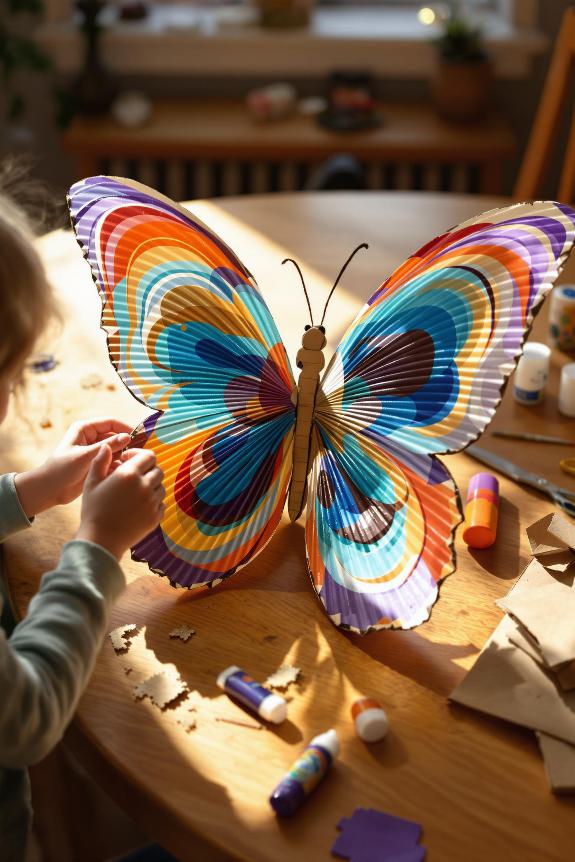
Young artists can release their creativity while helping the environment through eco-friendly cardboard art projects.
You’ll find endless possibilities for transforming everyday cardboard into stunning works of art that teach important lessons about sustainability.
- Create colourful sculptures using painted cardboard tubes, decorating them with yarn, fabric scraps, and buttons.
- Design unique masks by cutting and embellishing cardboard with eco-friendly paints and natural materials.
- Transform cardboard boxes into miniature cityscapes or underwater scenes.
- Make handbound notebooks from recycled cardboard, perfect for sketching or journaling.
- Craft decorative lanterns by cutting patterns into cardboard and adding LED lights.
These projects don’t just spark creativity; they help kids understand the importance of reusing materials.
You’ll watch them develop problem-solving skills while learning that beautiful art doesn’t require new materials.
Imaginative Play Structures

When you transform cardboard boxes into play structures, a world of imaginative possibilities opens up.
Using scissors, paint, and tape, you can create houses, buildings, vehicles, and even entire cityscapes.
Turn large boxes into cosy playhouses with cut-out windows and doors, or craft impressive castles with turrets made from paper towel rolls.
If you’re feeling adventurous, you can build race cars, spaceships, or pirate vessels that’ll transport young minds to exciting destinations.
For community-minded creators, cardboard and basic crafting tools can be used to design miniature cities with roads, buildings, and playgrounds.
Each project helps develop important skills like problem-solving, spatial reasoning, and fine motor coordination while encouraging creative expression through hands-on building activities.
Sensory Learning With Cardboard
Beyond building structures, cardboard offers rich opportunities for sensory investigation and learning.
You’ll discover endless ways to engage your child’s senses through simple cardboard materials like tubes and boxes.
Transform ordinary cardboard into exciting sensory experiences that support development and learning.
- Create sound investigation tubes to listen to amplified sounds and test different noises.
- Design touch-and-feel boards with various textures cut from cardboard
- Fill cardboard boxes with sensory materials like rice, sand, or shredded paper
- Make recycling-themed sorting bins to teach environmental awareness
- Use cardboard tubes as viewing tools to examine visual perception
These activities help develop fine motor skills, enhance cognitive learning, and encourage sensory integration.
You can easily modify them to suit different ages and developmental stages, making cardboard an essential tool for sensory learning.
Outdoor Cardboard Adventures

Taking cardboard play into the great outdoors opens up endless possibilities for creative adventures and learning experiences.
Large cardboard boxes can transform into magical forts, playhouses, or even themed sailboats, where your children’s imagination can soar.
They can decorate these structures with paint and fill them with cosy pillows for the perfect outdoor retreat.
For nature enthusiasts, cardboard becomes a canvas for environmental exploration.
You can help your kids create nature boards using wildflowers and leaves or craft telescopes from toilet paper rolls for backyard safaris.
Remember to set up exciting cardboard obstacle courses and marble runs that’ll challenge their problem-solving skills.
These outdoor activities will not only entertain but also help develop motor skills while nurturing a deep connection with nature.
Recycled Gift-Making Projects

Transform ordinary cardboard into extraordinary gift boxes that delight family and friends while teaching significant lessons about sustainability.
You can create custom boxes perfect for any occasion with basic materials like scissors, glue, and decorative paper. The process develops vital skills while having fun.
Here’s what your kids will learn while making recycled gift boxes:
- Problem-solving through measuring and constructing
- Fine motor skills by cutting and folding precisely
- Environmental awareness through creative reuse
- Spatial reasoning by planning box dimensions
- Artistic expression through decorative techniques
Start with simple square boxes, then experiment with different shapes and sizes.
Add personal touches using paint, washi tape, or recycled paper. You’ll be amazed at how ordinary cardboard transforms into beautiful, meaningful gifts that recipients will treasure.


